

As Gaza’s children die, the Israel Medical Association mustn’t stand idly by again
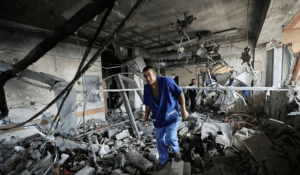
Destruction at Nasser Hospital in Khan Yunis, Gaza, after an Israeli strike in May. Around 4,000 children in the enclave need operations and other life-saving care that’s unavailable there
Barry Danino and Michal Feldon write in Haaretz on 30 December 2025:
Around a month ago, five human rights groups asked the Supreme Court to order the state to resume the evacuation of patients from the Gaza Strip to hospitals in the West Bank and East Jerusalem. The petition was designed only to allow the transit through Israel of patients waiting for medical care in East Jerusalem and the Palestinian-administered areas of the West Bank.
It wasn’t a request to restore the situation before the war, when such patients were also treated in Israel, though even back then the treatments were paid for by the Palestinian Authority rather than Israel. The state has yet to respond to the petition.
As physicians in contact with medical staffers in Gaza, we hear stories every day about cancer patients and others whose lives are at risk because they need urgent treatments that don’t exist in Gaza. So three weeks ago we were part of a group of doctors – all heads of professional associations or companies, or senior administrators at Israeli public hospitals – that asked the Israel Medical Association’s ethics office to consider the matter. Last Wednesday, we were told that the answer was no.
The head of the ethics office, Dr. Yossi Walfisch, wrote in his brief response that the decision on transferring patients from Gaza to Israel for medical care is “a political issue and not the business of the ethics office.” He added that “to the best of my knowledge, a channel has been opened allowing patients from Gaza to be taken to neighboring countries.”
Of course, any decision the state makes is a political decision. But in this case, the decision clearly contradicts the oath sworn by Israeli doctors: “On your watch, you are responsible day and night for standing at the patient’s right hand in his distress, at all times. And take great care to preserve every person’s life from his mother’s womb, and let his welfare be your chief glory all your days. And help the sick person because he is sick, whether he is a foreigner, a gentile or a citizen, whether he is lowly or important.”
Given this contradiction, the Israel Medical Association must not stand idly by the way it did more than once during the recent war. In many cases, after we drew its leaders’ attention to an issue, like opposition to letting in medical equipment and attacks on medical staffers and their disappearance into the Israeli prison system, the IMA came to its senses and stood on the right side.
Now as then, keeping silent and standing idly by are a clear position – one of moral collapse. Aside from the Israeli medical oath, preventing patients from receiving treatment because of their origin, birthplace or place of residence is an unequivocal violation of both medical ethics and international law.
A “channel … that allows patients from Gaza to be taken to neighboring countries” means closing your eyes to reality, because there is no evidence that such a channel exists. Patients still can’t go to Egypt through the Rafah crossing between Egypt and Gaza. And because of the army’s policy and the pace at which requests for exit permits are considered, patients and/or the people accompanying them almost always fail to receive permits to leave through Israel.
So there is virtually no possibility of leaving Gaza to get treatment. And as Haaretz reported two weeks ago, some patients die while waiting to leave. In fact, since the cease-fire agreement was signed in early October, only a few patients have managed to leave Gaza to receive treatment in neighboring countries.
As we wrote this, 4,000 children in Gaza needed operations and other life-saving care. This included chemotherapy for cancer patients, biological treatments for inflammatory diseases, and special nutritional compounds for people with congenital metabolic diseases. None of this is obtainable in Gaza due to the collapse of the health system and other infrastructure during the war.
In contrast, Augusta Victoria Hospital in East Jerusalem, to give one example, is ready right now to treat around 50 cancer patients – if only those children could get there.
Next week will be the 114th anniversary of the Israel Medical Association’s founding conference. The minutes say the association considered “health-related social problems” that should be “investigated and discussed at its own initiative, or at the suggestion of other organizations.”
It’s still not too late to hold a real discussion on this issue and stand “at the patient’s right hand in his distress, at all times. … And help the sick person because he is sick, whether he is a stranger, a gentile or a citizen, whether he is lowly or important.”
This article is reproduced in its entirety