

After Palestinian shepherd communities, forced displacement targets a new frontier
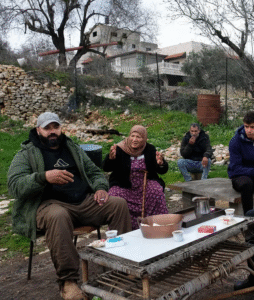
Left, Bilal Dar Khalil and his mother, Khadra, and second from right, activist Ayad Raffari, in Sinjil, January 2026
Gideon Levy reports in Haaretz on January 2026:
The homes remind one of those in an affluent neighborhood in Johannesburg: barbed-wire fences around imposing stone houses, electrified gates. In the South African city and in Sinjil, in the West Bank, as well, such barriers are erected to shield the inhabitants from surging crime. In the case of Sinjil the fear is of criminals from nearby settler outposts.
People in Sinjil have started to abandon their homes; 15 have recently been vacated, we are told. Only the quintessentially Palestinian, pastoral landscape remains: prickly pear cactuses and olive groves dotting the stunning valley.
In the past two years new, outposts of violent settlers have sprung up – mostly under the cover of the war in the Gaza Strip – on the hilltops that surround the village, northwest of Ramallah, and they have seized Palestinian land. The invaders’ aim is to force out the locals, and they declare as much explicitly when launching their attacks.
If until now the population transfer in the West Bank seemed to be focused on pastoralist communities – the weakest and most isolated population – when it comes to Sinjil, we’re talking about a town of 8,000 people whose existence is clearly under threat. The downtown part still looks the same, but the periphery, especially the northern section, across from the settlement of Shiloh and its satellites, is gradually coming to resemble a half-deserted frontier region. While some houses stand empty, in others residents are present during daytime hours, in order to guard their property – but they don’t dare to sleep there. One case in point involves a 78-year-old widow, Kautar Dar Khalil.
Sinjil lies on the west side of Highway 60, the main north-south thoroughfare of the West Bank. The stretch of the highway leading south from Tapuah Junction is flanked by hundreds of Israeli flags, planted every few meters by settlers in the past few months. You’ll see fewer flags in Tel Aviv on Independence Day.
No Palestinian will dare touch these foreign flags. The land is Palestinian – the flags are those of the occupation. It’s not hard to imagine what would happen to Palestinians who would have the temerity to raise their own national flag at the entrance to their villages.
A row of rocks has been arranged atop the concrete barricade that protects an area with bus stops and places where people stop for hitchhikers, across from the intersection where a road leads west to the settlement of Neve Tzuf. Apparently people waiting there can pass the time by stoning passing Palestinian vehicles.
The main entrance to Sinjil – a mispronunciation of St. Gilles, the name of a French village where a leader of the First Crusade built a castle – is blocked by a metal, military-issue gate, like all the main entrances to Palestinian communities in the territories. Thus, entry involves a sneaky, improvised effort, by way of an old section of Highway 60 that leads to the settlement of Ma’aleh Levona and the outpost of Givat Haroeh. We take a path that branches off from that road and end up at a locked metal gate, but this time, surprisingly, it’s a Palestinian gate – protecting the home of the family of farmer Bilal Dar Khalil.
After his house, located in the northern part of Sinjil, was first attacked by settlers, in 2022, he erected a fence around it and closed off the entrance with the gate. A youth hurries to open it for us. Ayad Raffari, a human rights activist, and Muhammad Rumana, a field researcher for B’Tselem – The Israeli Information Center for Human Rights in the Occupied Territories, accompany us inside.
Sinjil has lost 67 percent of its land since the occupation began in 1967, and 87 percent of its farmland to the settlers, Raffari says. But their appetite hasn’t been sated.
We’re standing in the yard of a compound encompassing Bilal Dar Khalil’s house, in bitter cold that’s alleviated slightly now and then when the sun peeks out from the clouds. A blue tent has been erected in the center of the yard, a sort of family battle headquarters, housing guards who take shifts watching over the property at night. Bilal, who’s 37 and has three children, says he never sleeps at night knowing that even in advance of an assault that may last just a few minutes, he must constantly safeguard his home, his sheep and above all his family; at any given minute there could be a violent incident. His mother, Khadra, 73, lives with them.
The family lives in unrelenting fear. Not a day passes without shepherds from the outposts invading the area, pasturing their animals on soil that doesn’t belong to them and frightening the inhabitants. The stone house and the storage room in the compound were built by Bilal’s grandfather in the early 1940s. Since the war broke out in Gaza, he tells us, he has not been able to take his flock to pasture or to access his land in the nearby valley – 20 dunams (5 acres) of olives, wheat and barley. This week we brought a soccer ball back to one of his children; it had been kicked onto the road beyond the gate of the compound; the boy had been afraid to go get it.
The family lives in unrelenting fear. Indeed, not a day passes without shepherds from the outposts invading the area, pasturing their animals on soil that doesn’t belong to them and frightening the inhabitants.
The first incursions into their compound took place at the beginning and at the end of 2022, Bilal says; the settlers stole four sheep each time. During a third raid, immediately after the war erupted, the encroachers attacked the women and children who were in the house and destroyed the family car. The army arrived and fired tear gas at… Bilal’s family. The path leading to the metal gate is strewn with the casings, a mute testimony.
Since the war broke out, the army has protected the assailants, the farmer tells us. Before that, the army sometimes protected locals who were under attack, but no longer.Bilal’s sister, Tagrid, who’s 58 and the mother of seven, once lived a few hundred meters from him. But since settlers threw a Molotov cocktail at her house, which set the yard on fire, a year and a half ago, she has lived with relatives in Sinjil.
Shortly before 11 A.M. on Thursday, January 8, two settlers, one of them armed with an M16 rifle, descended from a nearby hill with their sheep. “The settler with the rifle stood next to my neighbor’s fence and called out to me,” Bilal says in his worker’s Hebrew. “I asked him what he wanted and he said: ‘Get out of your house – it’s ours.’ I told him: ‘It is our house.’ He said: ‘It is ours. All the land is ours.’
“I said: ‘Go away, do not approach my house. I can still guard my house and my family.’ He said: ‘Call the army to come and guard you.’ I repeated: ‘I can guard by myself.’ The settler then walked toward my gate and called the army and told them to come. Some soldiers showed up.
The incident that followed was documented by video footage shot by one of Bilal’s relatives. Armed soldiers draw close to the house, barking at Bilal and his two brothers, who are standing on the other side of the gate. The soldiers kick the gate viciously and shout threats. At one point they fire a few shots into the air – for no apparent reason.
Standing across from them throughout are three unarmed men who are not endangering anyone and who are trying in vain to explain that this is their property and they are being menaced by settlers. Meanwhile, the two settlers stand at the end of the path, watching the events unfold. The soldiers’ behavior is bestial and disgraceful, albeit not physical; at least one of them snarls something unpleasant in Arabic.
A response to a query from Haaretz, the IDF Spokesperson’s Unit provided this comment: “The conduct of the settlers that was documented is being investigated. The protocol in such situations will be clarified.”
In the clip, Bilal is bold but relatively restrained in the face of the armed soldiers, quite an unusual sight. “They told me to open the gate,” he tells us. “I said: ‘You do not have authorization to enter my house. There are young children here and you are frightening them. Just try to come and kill us all.'”
Bilal says he told the troops that he feared that the invaders would burn down his home and kill some of its inhabitants, as happened to the Dawabsheh family in the town of Duma, in 2015, whereupon one of the soldiers retorted: “This is not your home.'”
After the soldiers fired into the air and threatened Bilal that if he and his brothers did not back off they would be shot, the three moved back, toward the house. The soldiers left, only to be replaced by another unit shortly afterward. “Who is the person who shouted at the soldiers?” one of them demanded. They fired tear gas at the yard and the house. “Only God will help us,” Bilal mutters now.
Not far away is the home of a widow, Kautar Dar Khalil, one of Bilal’s relatives; smoke rises from the wood-burning fireplace in her living room. The house, accessed through an electrified gate that opens via remote control, projects affluence. Like in a situation room, a huge TV screen in the living room constantly broadcasts images from four closed circuit cameras erected around the house. All the windows are barred, like a prison.
Video footage shows what happened here last Thursday: A settler approaches the fence around the woman’s house with his sheep, stands opposite the CCTV cameras and starts to throw stones at them. One of the cameras is shattered and stops working. According to Raffari, the local activist, Kautar was alone at home when she saw the settler approaching and throwing stones. She called Raffari, who was then in Ramallah; he told her that until he got there, she should go into an inner room and not to be afraid.
Since the war Kautar has lived alone, after other members of her family who had lived with her left, due to the threat of settler violence. She alone watches over the house during the day, before going to the home of one of her children in Sinjil to spend the night. She has lived in the house for more than 50 years. A photograph of her husband, Abdel Muna’im – who worked as a cook in restaurants in Tel Aviv and at a few Jerusalem hotels – died a few years ago, hangs in the living room. If he were alive he would show the settlers what’s what, she says.
In another video, taken by Raffari last Saturday, a settler youth with long sidelocks is seen peering through the gate with a provocative smirk on his face. Raffari tells him to leave – “This is private property” – and threatens to call the police. The youth replies: “Yallah, go bring them, ya sharmutas [you whores].”
This article is reproduced in its entirety