

After the Iran war, Gaza and Lebanon, how to prevent the complete death of international law
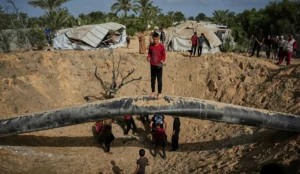
Palestinians inspect the destruction caused by an Israeli strike in Khan Younis, southern Gaza Strip, 19 May 2026.
Luciano Zaccara writes in The New Arab on 18 June 2026:
“Illegal” has become one of the most used words in the Middle East’s expanding wars.
In Gaza, Israel’s conduct has been repeatedly recognised as genocide, collective punishment and violations of international humanitarian law. Israel’s continued occupation of Palestinian territories has been declared unlawful by the International Court of Justice, while annexationist plans for Gaza and the West Bank continue.
US attacks on Iran were denounced by Tehran and others as acts of aggression and violations of the UN Charter.
Iranian attacks against GCC states are condemned as violations of sovereignty and international law.
Israel’s military operations in Lebanon are considered an unlawful invasion, destruction and occupation.
Yet Gaza is still being destroyed, Lebanon remains under attack, Iran and the United States have only just stopped exchanging fire, and GCC states remain exposed to missiles and drones if the fragile US-Iran deal collapses after the 60-day deadline expires.
The law is speaking constantly. The problem is that it is not stopping anything. The crisis is saturated with legal language.
The International Court of Justice has issued provisional measures in the Gaza genocide case and stated that Israel’s continued presence in the occupied Palestinian territory is unlawful. The International Criminal Court has issued arrest warrants against Israeli leaders. The Security Council has adopted resolutions on ceasefires, sovereignty and international humanitarian law. Regional organisations, states and human rights bodies have all used legality to describe the crisis.
But there is a growing distance between legal designation and political consequence. The word “illegal” still has legal meaning. It creates a record, frames responsibility and may shape future accountability.
But in the immediate conduct of war, it appears unable to restrain those with the military capacity, political protection or strategic justification to continue. This is not the silence of international law, but the exhaustion of legal condemnation.
The Middle East is suffering from legal inflation. Like a currency printed without sufficient reserves, the term “illegal” circulates everywhere, but it is backed by too little. Each statement adds to the legal archive, but not necessarily to the capacity to prevent the next strike, invasion, or annexation plan. This does not mean that legal opinions are irrelevant. International law matters because it defines obligations, exposes violations and limits states’ ability to claim innocence.
The problem is different: law is invoked, but not enforced; cited, but not operationalised; repeated, but not converted into consequences