

Gazan Dr. Hussam Abu Safiya is our generation’s Janusz Korczak
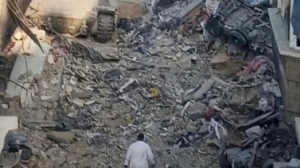
The last known image of Dr Hussam Abu Safiya before his arrest shows him walking in a white lab coat towards Israeli tanks
Michal Feldon writes in Haaretz on 14 June 2026:
My 10-year-old son saw a photograph earlier this week of Dr. Hussam Abu Safiya, taken in Nafha Prison and projected in the High Court of Justice chamber. Dr. Abu Safiya appeared emaciated, his forearms covered in cuts and his face expressionless.
My son asked who the man was and why he looked that way. I tried my best to explain: “He is a pediatrician, like me, but he also managed a hospital in Gaza and saved thousands of lives through his work.”
“But why is he in prison?” my son insisted. “He can’t just be sitting there for no reason.”
“There is no reason,” I replied. “He is simply a doctor from Gaza. He didn’t do anything wrong.”
“Okay,” my son said, “at least that won’t happen to you.”
I could have left him with that childlike hope, but it weighed on me, so I answered differently: “The moment humanity allows such things to happen in Gaza, they can happen here too. It’s only by chance that he was born in Gaza and I was born in Israel.”
Dr. Abu Safiya’s arrest photo from December 2024 is etched into the world’s consciousness: a senior doctor and hospital director, dressed in a white coat, emerging last from the besieged and bombed hospital, only after all patients and staff had been evacuated. He walks through the ruins toward the tank that would take him into what has become, according to his lawyer, at least a year and a half of torture, starvation and humiliation.
The world also knows his story. He received his medical training in Kazakhstan and married there, but chose to return to his home in Gaza.
Kamal Adwan Hospital in northern Gaza, under Abu Safiya’s management, came under repeated Israeli attacks from December 2023 onward. Abu Safiya refused to leave his patients despite his family’s pleas, and his entire family moved into the hospital. In October 2024, he was arrested for several hours during a raid in which his son Ibrahim was killed in a drone strike near the hospital entrance.
After his son’s funeral on the hospital grounds, which was broadcast around the world, Abu Safiya began issuing frequent video updates from Kamal Adwan. He continued doing so until he was wounded in another strike on the facility a few weeks later.
Six pieces of shrapnel struck his leg. Yet at the end of the surgery, which he also broadcast, he recorded another video about the hospital’s condition from his intensive care unit room. Kamal Adwan remained the last functioning hospital in northern Gaza until Israeli forces took control of the facility in December 2024.
Like thousands of other Gazans detained by Israel during the war, Dr. Abu Safiya is being held under the Unlawful Combatants Law without formal charges. His detention has been repeatedly extended, typically in six-month increments.
According to Physicians for Human Rights, 13 other doctors and dozens of medical staff members are detained alongside him. Lawyers from Physicians for Human Rights Israel, which represents the detainees, along with medical workers who were detained and later released in hostage-prisoner exchange agreements, describe a system in which detainees are forbidden from contacting their families. In many cases, relatives did not know for months that their loved ones were being held.
From testimonies gathered from released detainees, we know of torture, including beatings, dog attacks, prolonged standing and constant shackling of hands and feet. We know of skin and respiratory diseases and inadequate medical care. Doctors have described lancing abscesses for fellow prisoners with whatever objects they could find, without disinfection. We know of starvation and insufficient access to water. We also know that three senior doctors died in prison under circumstances that remain unclear.
In recent months, I have spoken with several families of detained doctors.
Dr. Arwa Abu Taima, a gynecologist and mother of nine, now supports her children alone in a tent in Khan Yunis after her husband, Dr. Nahed Abu Taima, a surgeon, was arrested during a raid on Nasser Hospital in February 2024. She says she did not learn what had happened to him until November 2024, when a lawyer was finally able to meet him. When I offered her financial assistance, she firmly refused. She repeated that she wanted only one kind of help: help in securing her husband’s release. She asked that we demonstrate, write and speak out. What she wanted, she said, was political help and political power, not money or food.
Yet public pressure can sometimes harm detainees. Dozens of petitions bearing tens of thousands of signatures have been circulated on behalf of Dr. Abu Safiya, and a petition demanding his release was recently filed with the High Court of Justice. Days after the appeal was submitted, however, Dr. Abu Safiya was transferred from his cell in Ketziot Prison to solitary confinement in Nafha Prison.
At a court hearing on June 10, Dr. Abu Safiya conveyed a single sentence through his lawyer: “I am a pediatrician who provides medical services and care to the sick, wounded and vulnerable people of Gaza. My detention here is unjust and arbitrary, and I demand my immediate release.”
Almost everyone knows the story of Janusz Korczak, the doctor who refused opportunities to save himself when the children of the orphanage he ran were deported to Treblinka. He accompanied them to the camp and became one of the enduring symbols of heroism in the 20th century. Even my children asked to light a memorial candle for him on the last Holocaust Remembrance Day.
Dr. Abu Safiya is the Janusz Korczak of our generation. He is tortured and starved in an Israeli prison, and his life may be in danger. If the High Court of Justice does not order his release, no Israeli court or authority will be able to avoid direct involvement in the annihilation of a Palestinian symbol of heroism.
The author is a physician.
This article is reproduced in its entirety