

Israel’s systematic campaign of ethnic cleansing and crimes against humanity in the West Bank
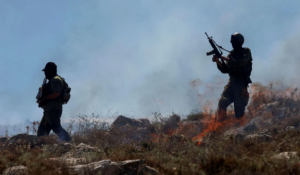
Israeli troops walk amid smoke rising from a fire started by crowd control grenades, during a protest against a settlement near Hebron, 9 June 2026
Ehud Olmert writes in Haaretz on 18 June 2026:
The fight against Jewish terrorism in the West Bank must advance to the next stage and be waged with greater determination. The daily terrorism that is managed, directed, encouraged and supported by the Israeli government can no longer be tolerated.
What is happening across the West Bank today is not the work of “70 kids … from broken homes,” as Prime Minister Benjamin Netanyahu once tried to claim, disingenuously. Nor are these the crimes of a small, anomalous minority among settlement residents, as some leaders of the settler movement often contend.
-Today, it must be said that the State of Israel is conducting an organized, systematic, state-funded campaign of ethnic cleansing and crimes against humanity. Not in the Gaza Strip, not in southern Lebanon, not in Syria, but in areas of the West Bank that are under the exclusive security control of the state and its security and law enforcement apparatus.
At the forefront of this campaign are the prime minister, Defense Minister Israel Katz and the rest of the cabinet, of course. The drive behind these acts is reflected in the statements and actions of senior ministers who seek the full annexation of the West Bank without their Palestinian inhabitants remaining there. I am referring specifically to Itamar Ben-Gvir, Bezalel Smotrich and the other ministers who support, through word and deed, policies that amount to the expulsion of Palestinian residents.
These are harsh words. Never before have such serious accusations been leveled against an Israeli government and the entire defense establishment, certainly not by someone who once held ultimate responsibility for Israel’s security. But after a long and painful period of restraint, there is no choice but to say these things plainly and in full.
Nothing can justify turning a blind eye to what is happening daily in Palestinian villages across the West Bank: pogroms, children and adults injured in and outside their homes, fields and property set ablaze, and large-scale theft – especially of cattle and sheep, the primary source of livelihood for many residents. Faced with all this, it is impossible to remain calm, forgiving or unwilling to confront the perpetrators, their supporters and their leaders.
Over the past two years, Israel has been accused on nearly every international stage – including by friendly countries that have stood by it in times of conflict and crisis – of committing genocide in Gaza. I have said at every opportunity that Israel neither committed nor intended to commit genocide in the Strip.
True, Israel fought the war that followed Hamas’ atrocious October 7 massacre with brutality and, at times, through actions that can only be described as war crimes. We all know such things occurred, even if we were unwilling to admit it. But the government did not pursue a policy of genocide, nor did it deliberately and systematically support actions that meet the legal definition of genocide.
On several occasions, including in Haaretz, I acknowledged that war crimes had indeed been committed. Foreign media outlets were eager to hear me accuse the government of responsibility for those crimes and claim they were carried out with the knowledge and consent of its leaders. I resisted that interpretation, and I do not regret it. I know that many who fought in Gaza, and who took part in some of its harshest episodes, continue to struggle with feelings of guilt over actions carried out by them or their units. Many pilots, too, wrestle with the emotional burden of operations that resulted in the deaths of innocent civilians. Some have told me so themselves.
But Israeli service members – whether in the air force, artillery, armored corps or infantry – were not the ones who set the targets or determined the objectives. They carried out orders. Those orders were at times reckless or poorly considered, and often issued without adequate consideration of the civilian casualties they might cause. But there was no conscious decision, no deliberate policy – by the government or any of its members – to authorize actions intended to result in mass killings.
Therefore, even if crimes that cannot be ignored or denied did occur in Gaza, there was no government policy behind them, and thus no justification for issuing arrest warrants against the prime minister, the defense minister or senior military commanders. That is what I believed then, and it is what I believe today. These conclusions do not apply to what has been happening in the West Bank in recent years, and especially in recent months.
Here, I do not hesitate to assign direct and immediate responsibility to the government for war crimes and ethnic cleansing directed against hundreds of thousands of Palestinians who have no involvement in terrorism, directly or indirectly.
The thousands of settlers involved in these crimes could not act without the assistance, protection, backing and funding provided by government agencies at both the local and national levels. Crimes of this scale – including serious sexual abuse, even if not exactly as described by Nicholas Kristof in The New York Times – would not be possible without support at every stage.
The Israel Police are, in practice, partners in what is taking place in the West Bank. They do not attempt to prevent these acts, despite their duty to do so. In many cases, security forces actively assist Jewish terrorists – and, remarkably, it is almost always the Palestinian victims who are arrested, rather than the perpetrators.
Too many cases have emerged in which IDF soldiers, both conscripts and reservists, have been involved in assaults and attacks against Palestinians. The IDF Spokesperson routinely responds by saying such incidents do not reflect the army’s values or policy. But this has become little more than a hollow ritual. The reality is that soldiers in various locations continue to take part in violent and at times even deadly attacks on Palestinian residents.
Nor can the failures of the Shin Bet in preventing and exposing Jewish terrorism be ignored. The domestic intelligence agency, like the IDF, is deeply important to me. Over many years, I worked closely with its commanders and operatives and came to know their dedication, courage and professionalism. But I also know their capabilities. There is no convincing explanation for why the Shin Bet is not using the tools at its disposal to confront the rampant Jewish terrorism in the West Bank. The agency bears responsibility for preventing terrorism, whether Palestinian terrorism – a mission it carries out with considerable success – or Jewish terrorism.
These failures did not begin under the current Shin Bet chief, nor is this an attempt to discredit him amid the legitimate debate surrounding his appointment. They are longstanding failures, and there is no reason to accept them as inevitable.
Israel’s law enforcement authorities have a duty to take the necessary steps to stop what Jews are doing in the West Bank. But given the certainty that the government will not act, that the defense minister will continue refusing to authorize administrative detention orders against Jewish suspects, that the police will continue cooperating with perpetrators, and that the military will continue looking the other way, there is a real possibility that the international community will begin taking far more forceful action against the individuals, organizations and government responsible for these crimes.
The U.S. administration and European governments – coordinating their investigative and law enforcement systems – may end up doing what Israeli authorities have so far failed to do: Act against the terrorism that Israel continues to allow in territories under its control and responsibility. It is also likely that the International Criminal Court in The Hague will take more targeted and forceful measures against leaders and perpetrators, many of whom are well known and easily identifiable, in an effort to curb these crimes.
The instinctive response of the Jewish terrorists and their supporters – and, at times, of many decent and well-meaning Israelis – is to dismiss criticism, hostility toward Israelis abroad, or actions against Israeli and Jewish institutions as antisemitism. Antisemitism undoubtedly exists, and it has intensified in recent years. It has been a constant feature of Jewish history. But it should not be confused with condemnation of what the Israeli government is doing or with opposition to policies and actions carried out in Israel’s name.
Can anyone seriously believe that the violence Israelis inflict on Palestinians can simply be brushed aside – and that people around the world, who see the destruction, hatred, persecution, arson and brutality carried out by Israelis, will close their eyes to it as so many of us do here?
It is time to stop the self-righteousness, the hypocrisy and the charade – and confront the enemies within.
This article is reproduced in its entirety