

This West Bank town reveals: bloodshed is Israeli government policy and it crosses the Green Line
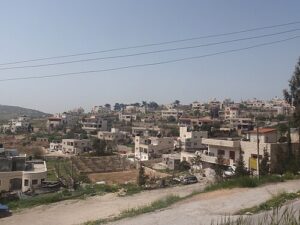
Beit Ummar in 2011
Nagham Zbeedat writes in Haaretz on 2 June 2026:
For four years, a feud between two Palestinian families has held the West Bank town of Beit Ummar hostage.
Seven people have been killed. Homes and businesses have been burned. Residents speak of avoiding the streets out of fear that a stray bullet or mistaken identity could turn them into the next victim. What began as an argument on social media spiraled into a cycle of killings, revenge attacks and collective fear that now affects nearly every aspect of life for the town’s roughly 20,000 residents.
When I spoke to one resident this week, he was not asking for more soldiers, more raids or more arrests.
He was talking about reconciliation. According to him, local figures, clan elders and mediators have repeatedly attempted to broker a sulha (reconciliation) between the two families. The latest effort collapsed just days ago after a renewed outbreak of violence. But he also said that Palestinian Authority officials and mediators attempting to intervene have faced restrictions, detentions and obstacles imposed by the Israeli military.
Israel may dispute those allegations. But the story of Beit Ummar points to a deliberate trend that extends far beyond the West Bank.
Palestinians are constantly told that violence is one of their greatest problems. That they are plagued by internal division and weak institutions. Yet whenever Palestinians try to build mechanisms that could address these problems, their efforts are often met with Israeli intervention.
Last year, Israeli authorities outlawed the committees of Ifsha al-Salam, an Arab organization in Israel that promotes reconciliation between feuding families and is headed by Sheikh Raed Salah, the former leader of the northern branch of the Islamic Movement in Israel. Whatever one thinks of Salah, the committees themselves were dedicated to mediation within Arab communities in northern Israel suffering from unprecedented levels of violence and homicide.
While Palestinian citizens buried victim after victim and demanded action against organized crime, one of the few grassroots frameworks attempting to reduce tensions and resolve disputes was dismantled.
This same pattern is visible in Gaza.
For months, Israel has argued that Hamas must be replaced. At the same time, Palestinian political factions, clan leaders and independent figures attempting to formulate consensus-based alternatives have struggled to gain traction. Instead, Israel is reportedly backing armed militias and local groups willing to cooperate with its vision for postwar Gaza.
The message is difficult to ignore.
When Palestinians try reconciliation, they face obstacles. When they attempt political consensus, they’re met with more roadblocks. And when they try to organize independently, more barriers still. For decades, Israeli leaders have pointed to Palestinian division as proof that there is no partner for peace. But this division did not emerge in a vacuum. It survives because it is useful.
A reconciled Palestinian society can organize. A united Palestinian front can make demands. A legitimate Palestinian leadership can negotiate from a position of strength.
But a society that stays fragmented remains consumed and weakened by its own crises.
The resident from Beit Ummar was not asking for weapons, arrests or revenge. He was asking for people to sit in a room and end a conflict before another young man is killed. That is what makes his story so revealing. If Palestinians cannot even reconcile with one another without encountering obstacles, the problem is clearly larger than one single feud.
The continuation of Palestinian bloodshed is not a failure of policy. For those invested in maintaining the status quo, it has become part of the policy itself.
This article is reproduced in its entirety