

A few months after deadly raid, police storm Bedouin village, fire stun grenades, residents say
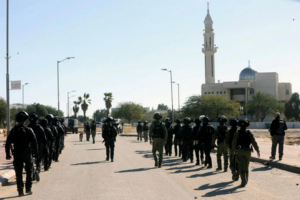
Heavy police forces enter the Bedouin town of Tarabin in January 2026
Eden Solomon reports in Haaretz on 4 April 2026:
Residents of the southern Israeli Bedouin village of Tarabin reported on Friday a violent police raid, including the firing of tear gas, stun grenades and rubber bullets. According to residents, police forces entered the village to search for a stolen ATV. Police said stones were thrown at them; five people were arrested on suspicion of attacking the forces and one woman was detained.
Village residents later said police returned to the village with reinforcements and continued what they described as harassment.
Atef al-Sana, a resident of the village, told Haaretz that police entered a house in Tarabin, confiscated an ATV on the suspicion that it was stolen, and detained an elderly woman before “returning with reinforcements to provoke people.”
“The whole village is full of tear gas. Why punish everyone?” he said, adding that his wife, who suffers from asthma, was affected by the gas.
“There were many security forces,” said another resident, Yasser al-Sana. “They damaged people’s cars, started throwing stun grenades and tear gas.” Another resident said his private vehicle was hit by rubber bullets.
In December, police launched a two-week operation following violent clashes that broke out in the village between officers and residents.
The events led to a large-scale deployment of the National Guard and the Southern District Police in the village, under the close supervision of National Security Minister Itamar Ben-Gvir.
During the operation, a resident of the village, Mohammed Hussein Tarabin al-Sana, was shot dead while being detained after suspicion arose that he had set fire to Jewish vehicles in the nearby Giv’ot Bar settlement.
Haaretz learned that investigators from the Justice Ministry unit responsible for probing police misconduct, known in Hebrew as Mahash, who str [sic] examining the circumstances of his death, did not arrive at the shooting scene in the immediate aftermath of the shooting, despite standard practice to do so.
Visiting a death scene is a basic step in such investigations and is intended, among other things, to collect testimony, locate surveillance footage, and independently assess the site.
This article is reproduced in its entirety