

Seven Palestinians killed in IDF Gaza strikes including two women and two girls
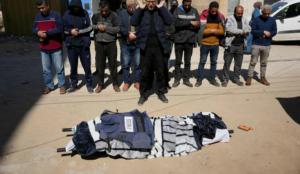
Funeral of journalist Amaal Shamali killed in the Nuseirat refugee camp, March 2026
Rawan Suleiman and Liza Rozovsky report in Haaretz on 9 March 2026:
Seven people were killed, and 17 were wounded in separate incidents of airstrikes and tank shellings by Israeli forces in Gaza on Sunday, the Hamas-run health ministry reported on Monday.
According to Palestinian media outlets, two women – a journalist and a 12-year-old girl were shot in central Gaza; one person was shot in Beit Lahia; a four-year-old girl was shot in Khan Yunis on Saturday who died of her wounds on Sunday; and two others were shot in western Gaza City.
A statement issued by the Israel Defense Forces referred only to the targeting of the two men killed in western Gaza City, claiming they were Hamas operatives who planned to harm Israeli forces. However, the army did not provide a statement regarding the circumstances of the targeting of the other five persons killed.
The journalist killed, Amaal Shamali, worked for Qatar Radio and was hit by shellfire in the western Nuseirat refugee camp. The Palestinian Journalists Syndicate organization eulogized Shamali, who was 46 at the time of her death, and said 260 journalists have been killed, including 38 female journalists, since the beginning of the war that broke out on October 7, 2023.
“This is the bloodiest time for female journalists in human history,” the organization said, “which testifies to the scope of the intentional harming of Palestinian journalism in the attempt to silence the voice of truth and prevent the documentation of the crimes the Palestinian people are subject to.”
Meanwhile, the Board of Peace headed by U.S. President Donald Trump and the office of its High Representative for Gaza, Nickolay Mladenov, are conducting contacts with the Israeli government regarding the reopening of the Rafah crossing in both directions, a diplomatic source confirmed to Haaretz.
At the beginning of last week, the Coordinator of Government Activities in the Territories (COGAT) announced a partial reopening of the Kerem Shalom crossing to allow the delivery of humanitarian aid to the Gaza Strip. This came less than three days after Israel and the United States launched a war against Iran, after which Israel announced the closure of all crossings into Gaza for security reasons. The state also announced the closure of the Allenby crossing from Jordan to the West Bank for the transport of goods, some of which are destined for Gaza.
Haaretz learned that COGAT’s decision to partially reopen the Kerem Shalom crossing was made after a senior adviser to the Board of Peace and to U.S. special envoy Steve Witkoff, Aryeh Lightstone, raised the issue directly with Prime Minister Benjamin Netanyahu. Since then, the other crossings – including Rafah, the only crossing designated for the entry of Palestinian residents into the Gaza Strip – have remained closed. In recent months, a small number of Gazans have left the strip via Kerem Shalom as part of evacuation operations. A security source told Haaretz that no directive has yet been issued by the political leadership to reopen the Rafah crossing, and that at present the conditions on the ground do not allow for it.
This article is reproduced in its entirety