

‘I would never do it again’: Inside the struggle to enter and leave Gaza
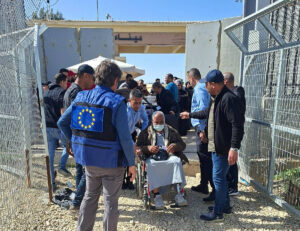
A Palestinian man passes through the Rafah Crossing under the supervision of EUBAM personnel
Ruwaida Amer reports in +972 on 13 February 2026:
The journey back to Gaza begins by night, and with little advance warning. From the Egyptian coastal city of El-Arish, Palestinians permitted to return to the Strip — averaging around 35 per day since the limited reopening of Rafah Crossing on Feb. 2 — hurriedly pack their bags and board a bus that brings them to their first security screening, on the Egyptian side of Gaza’s civilian entry point.
“We were met there by the Egyptian delegation and the Red Crescent, and their reception was wonderful,” Sabah Al-Reqeb, who arrived at the crossing with her five children in the early hours of February 5, told +972 Magazine. “The problem was on the other side.”
After an inspection by Egyptian forces, returnees pass through a narrow checkpoint surrounded by barbed wire fences that takes them to the Gazan side of the crossing. “I felt like I was in a prison,” Huda Abu Aabed, a woman in her 50s who returned to the Strip with her daughter on Feb. 8, recounted. “The Palestinian side didn’t look Palestinian at all.”
At the end of this checkpoint, returning residents are greeted by Palestinian Authority personnel operating under the supervision of the European Union Border Assistance Mission at the Rafah Crossing Point, known as EUBAM. Here, they must undergo another inspection, which reportedly involves facial recognition checks as well as bag searches that prohibit the entry of liquids or metals, any more than one bag per person, sums of money greater than NIS 2,000 (around $650), cigarettes, and electronic devices besides a single mobile phone.
In practice, this means that many of the returnees’ belongings are confiscated. “I told them I had clothes, cigarettes, and other belongings with me, but they said I had to give them all up,” Al-Reqeb recounted. Abu Aabed, meanwhile, was forced to part with her solar-powered flashlight and children’s toys, keeping only a few clothes and the medications she needs for her high blood pressure, diabetes, and heart condition.