

Too Palestinian or too real? This logo drove Israel’s government crazy for a reason
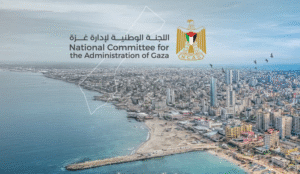
The new logo as displayed on NCAG’s official X account.
Dahlia Scheindlin writes in Haaretz on 6 February 2026:
Maybe it was a slow day, but for several hours earlier this week, the top Israeli morning news bulletins informed listeners of a grave incident: The “National Committee for the Administration of Gaza” concocted by U.S. President Donald Trump bore a logo that was nearly identical, save for the color of the eagle’s wings, to the logo of the Palestinian Authority.
Influential right-wing Israeli commentators were indignant, and opposition figures mocked the government for permitting the PA back to Gaza, while naturally avoiding any hint of support for Palestinian governance or a state. Prime Minister Benjamin Netanyahu was rankled by the criticism and issued a flustered comment that the new logo was not at all like the logo he was shown in earlier meetings – a chip off the line “they didn’t wake me up on October 7.”
Even Israeli radio announcers seemed to experience a bout of language nationalism, and decided to explain that the word “logo” – which Israelis usually borrow from English as is – should be called “samlil,” the formal Hebrew word based on “semel,” meaning symbol. But what does this symbol stand for that got Israelis so upset?
After all, the NCAG is one of about five unwieldy international bodies now charged with somehow running Gaza. It is supposed to comprise politically unaffiliated technocrats, charged with executing the will of international masters like Trump’s Board of Peace and its executive committees run by foreign luminaries like Tony Blair or the former UN Special Coordinator Nickolay Mladenov.
As such, the Palestinian NCAG has the least power of any of the new bodies. Established in January, Israel has not even allowed the group to meet in Gaza yet (maybe soon, according to recent reports). As for the actual Palestinian Authority, most Palestinians loathe the decrepit, corrupt administration, which is at once authoritarian, starved of funds by Israel and verging on collapse. So why does Israel care that much?
Israelis care because the symbol doesn’t stand just for the aspirational return of a failing PA to Gaza. It symbolizes a greater battle over just what this American initiative has actually spawned.
The Israeli government only agreed to the whole phase two of Trump’s plan as a gesture to the great global power that feeds it. And despite agreeing to Trump’s plan, the Israeli leadership presumably did so assuming, like the pundits, that the structure is a fiction.
Therefore, what generated a scandal in Israel was the idea of any Palestinian government at all. No matter how many pundits call the new structures a farce or a distraction – the very hint that a Palestinian government might exist in Gaza is anathema. The only authority that should ever rule Palestinians, in Israel’s mind, is Israel.
After all, the government makes no secret of its intentions to rule Gaza forever, even if it’s not formal policy. Justice Minister Yariv Levin gave the opening speech at a conference in mid-January billed as the right-wing plan for the day after in Gaza. The conference was the initiative of coalition lawmaker Simcha Rothman, from Religious Zionism, and a far-right civil society activist.
In between rounds of applause, Levin said: “We need to be in Gaza and in all parts of the Land of Israel…not only for security reasons, but because the Land of Israel belongs to the Israeli nation alone.” Referring to the burgeoning settlements in the West Bank, he said, “What’s right for Judea and Samaria is right for Gaza.” Levin then told the crowd that he “never had any doubt that we would return [to Gaza], that we would build.”
Other speakers at the event spoke so elatedly about owning Gaza in the future that they proposed names for streets and beaches. There will be no need for fences around Jewish communities, said others, and the audience cheered at the implication – often made explicit – that the Palestinians would be gone.
This wasn’t some ragtag bunch of hilltop hooligans, which is how Netanyahu describes the Jewish pogromists of the West Bank. The conference was held in a packed Knesset auditorium, standing room only. Levin is a regular at these events; other ministers and lawmakers from Likud attended as speakers, alongside ministers and MKs from other ultranationalist coalition partners.
In their world, Jewish conquest of all of these lands is inevitable – it’s God’s will and promise. Any hint of Palestinian nationhood could ruin this Jewish destiny.
Beyond the cosmic dimensions, in the Israeli government’s mind, the plan was supposed to mean colluding with the U.S. to carve up Palestinian land and crush its national statehood efforts into so many parcels of real estate. The deal was meant to retrieve the hostages and set terms for the next phases that Hamas would surely break before any real transitional mechanism would set in, so that Israel could go fully back in.
But the logo symbolizes that the U.S. might in fact be doing something different, or at least permitting it: softly strong-arming Israel into a direction the government has sworn never to allow. Maybe Israel has been lured in by President Trump, who Netanyahu regularly refers to as the country’s best friend in history. If so, perhaps Israeli leaders might finally question the wisdom of transforming all international relations from rules-based diplomacy into personal whimsy. Sometimes it goes your way, sometimes it doesn’t. “Maybe I will, maybe I won’t, nobody knows,” is a classic Trump theme.
On the other hand, the logo could mean neither of these. Perhaps a symbol is sometimes just a symbol, a haphazard Palestinian experiment with graphics?
And if Israelis thought the graphic was just another mark of a “virtual” (read: fictional) Palestinian state, Netanyahu’s reaction could have been something like “who cares about more fake?”
In truth, it’s highly unlikely that this U.S. plan will result in anything good for Palestinians, and this logo won’t matter in the long run. But if it opens a critical conversation about Palestinian statehood in Israel – it’s about time. Maybe one day, some Israeli leader will give different answers.
This article is reproduced in its entirety