

IDF orders soldiers to prevent Palestinians from plowing their land in West Bank
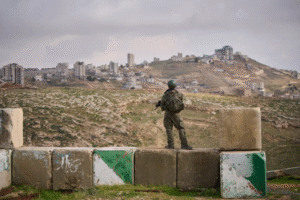
An Israeli soldier near a West Bank settlement, January 2026
Matan Golan reports in Haaretz on 11 February 2026:
The IDF ordered Israeli soldiers to prevent Palestinians from plowing their lands in the West Bank’s South Hebron Hills, also known as Masafer Yatta, Haaretz has learned.
Alongside efforts by Israeli settlers to prevent Palestinians from working their land, often at the start of the winter, soldiers were at times deployed to block Palestinian agricultural activity following requests by settlers.
“Plowing disruption” became a known code name for military activity, and for weeks, its thwarting became a central activity for these forces in the area, after they were briefed that plowing was not approved anywhere in the sector.
For this purpose, specific closed military zone orders were issued, and sometimes the forces also used crowd dispersal measures to drive away farmers and even detain them for hours.
Plowing is a vital agricultural activity carried out at the start of winter to prepare the soil for sowing. Land that is not plowed and planted on time will not produce a crop in the spring. Beyond the immediate harm to agricultural output, prolonged prevention of access and cultivation could ultimately lead to the loss of Palestinian ownership of the land.
If fields are left unplowed, they may be deemed abandoned, making it easier for the state to classify them as state land and assume control. The government’s initiative to renew land registration in the West Bank could further accelerate this process.
Talking to Haaretz, Dror Etkes of the Kerem Navot human rights nonprofit, says that since the 1980s, Israel has declared over 800,000 dunams in the West Bank as ‘state lands’ and “based on the claim that these areas aren’t cultivated or not sufficiently cultivated.”
“Many of these areas were previously cultivated, but for various reasons, their cultivation ceased,” he adds. “This means that Israel and the settlers have an interest in preventing Palestinians from cultivating lands in the West Bank, hoping that they can be declared state lands in the future.”
“This predicament is one of the main factors encouraging settler violence in the West Bank, with the belief that lands whose access has been blocked can be declared state lands in the future,” he said.
According to Kerem Navot’s assessment, in the last three years, Palestinian plowing has been prevented on over 100,000 dunams across the West Bank. Most of these lands have been taken over by farms, numbering about 140, whose grazing areas amount to approximately 900,000 dunams according to data from the Farms Association.
Land registration in the West Bank was frozen in 1967, leaving only about 30 percent of the land officially registered. As a result, the majority of agricultural land lacks formal ownership records. The World Zionist Organization’s settlement division allocates land to farms, ostensibly to preserve state lands.
In many cases, however, the division has allocated privately owned Palestinian land to settlers, using the initial allocation as a legal pretext to take control of the land.
A Palestinian landowner who experienced the army’s so-called plowing disruption firsthand told Haaretz that he has ownership documents for the land, “but the army came and prevented us from plowing.” “The soldiers told us they knew the land was ours, but we were forbidden to plow. We asked them ‘Why?’ and they couldn’t explain, but declared the place a closed military zone until the next morning.”
After the order expired, he returned to his land to try to plow it. “The same thing happened again,” he said. “Soldiers arrived and presented a closed military zone order. This happened three times on different days. They kept preventing us from plowing.”
In late November, in the South Hebron Hills, a regular service soldier prevented Palestinian plowing. “These are the orders we received,” the soldier said. “Our orders are that plowing is only permitted on private land” – most of the lands in this area have never been registered, so most residents do not have ownership documents for their lands – “and with the approval of the District Coordination and Liaison. Approval is required throughout the sector until otherwise defined. This whole area will soon be a closed military zone.”
Soldiers halting plowing were also reported in the Jordan Valley, the northern West Bank and the Ramallah area.
IAccording to army directives, residents’ access to their agricultural lands should not be prevented unless a closed military zone order has been imposed. The army is supposed to impose such orders only in cases of security issues, but the High Court of Justice ruled as early as 2006 that it was making disproportionate use of them. Last month, the High Court of Justice also ruled that the army appeared to be “trigger-happy” when it came to issuing the orders.
In response to a Haaretz query about whether the directives regarding plowing in the West Bank had changed, the army replied in December that it had not altered its procedures. “As a rule, plowing does not require prior coordination, except in areas where it has been so determined,” the army said. “The decision on which areas require plowing coordination is made according to the operational situation assessment and in accordance with the law applicable in the area,” it added. However, in practice, the army has prevented plowing many times.
In addition to the army’s activity to halt plowing, settlers also act to prevent Palestinians from cultivating their lands. For example, in November, settlers attacked Palestinians who were plowing their lands in the village of Arab al-Rashayida, southeast of Bethlehem. Several Palestinians were wounded and evacuated to the hospital. The army was called to the scene and separated the parties, but did not arrest anyone.
According to Palestinian reports, in the village of Deir Dibwan near Ramallah, settlers attacked Palestinians during plowing, prompting the army to use crowd-dispersal measures to separate the parties.
Last month, settlers also blocked Palestinian plowing in the village of Khalat Makhul in the northern West Bank. Palestinian testimonies state that settlers sprayed them with tear gas, while settlers claimed that Palestinians threw stones. Israeli security forces who arrived at the scene arrested two Palestinians, who were released two days later.
This article is reproduced in its entirety