

The IDF admits killing 70,000 Palestinians in Gaza. What other accusations may be true?
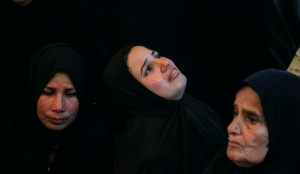
Palestinian women grieving in Khan Yunis, Gaza, 29 January 2026
Nir Hasson writes in Haaretz on 29 January 2026:
Israel’s eventual acceptance of the Gaza Health Ministry’s reported death toll should come as no surprise. Though Israeli officials heavily scrutinized the figures at the war’s start, no prominent Israeli spokesman has disputed them for several months.
The debate on the ministry’s credibility exists almost solely on social media and in Israeli mainstream media. Every single government, nonprofit organization and scholar who deals with Gaza accepts the ministry’s data and considers it very reliable.
To understand why the Health Ministry’s reports are reliable, we must first ask which contradictory information exists. But there are no contradictory reports. The most recent war in Gaza, which began on October 7, 2023, is the first war in Israeli history in which the IDF did not publish any official data on casualties from the opposing side.
The Gaza Health Ministry, meanwhile, published not only the overall death toll, but also compiled a detailed list of the majority of the dead, including their full names, the names of their fathers and grandfathers, dates of birth and identification numbers.
The list obtained by Haaretz, which compiles Palestinians who were killed in Gaza from October 2023 to October 2025, includes the details of 68,844 fatalities, comprising 96 percent of the death toll provided by the Health Ministry.
Overall, the list contains around half a million verifiable pieces of information. The fatalities who were counted in the toll, but do not have their full details in the list, are unidentified bodies or those for whom the Health Ministry does not possess full details.
Eighty percent of the details the ministry used to compile the list were provided by hospital morgues in the Strip, the ministry said. The rest of the fatalities were entered into the toll following reports by their family members. However, the ministry explained that these fatalities were only listed following a legal inquiry process that examined the evidence of their deaths.
In the months after the war began, the ministry’s lists were less reliable, and researchers found mistakes and duplications. However, over the last year, the mistakes were remedied. Some names that were registered were removed for reexamination, and not all were relisted.
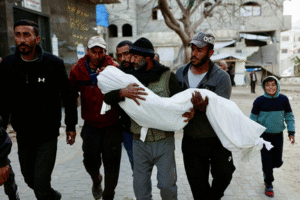
A man carrying the body of a 13-year-old boy in Gaza City, January 2026
Following the adjustments, the lists’ credibility was greatly improved, and researchers who attempted to dispute them did not find major errors. Some scholars believe that the war’s overall death toll – including those who died from its effects and those killed and still buried under the rubble – is significantly higher than 70,000. In fact, academic studies from recent months estimate that the war has claimed the lives of over one hundred thousand Palestinians.
The Israeli public must ask itself what the IDF’s belated recognition of the Palestinian death toll indicates about the credibility of claims by the army and government regarding other aspects of the fighting in Gaza: from open-fire regulations, to the abuse of Palestinian detainees, looting, the positioning of hospitals and Hamas facilities, and the inordinate destruction.
The dispute over the number of fatalities may be approaching an end, but the debate on their identities is still expected to trudge on. However, the IDF’s recognition of the Health Ministry’s count only validates the claim that Israel’s data regarding the civilian casualty ratio does not match reality.
Prime Minister Benjamin Netanyahu has claimed that the ratio between combatants and civilians is 1:1 or 1:1.5. U.K.-based nonprofit organisation Action on Armed Violence published a contradictory study this week, according to which for every combatant killed by Israeli fire, five civilians were killed – meaning 83 percent of all casualties were civilians.
The Action on Armed Violence study is one of many that estimate that the civilian casualty ratio was significantly higher than the ratio claimed by Israel. Just as Israeli officials are now beginning to accept the Palestinian death toll they initially rejected, they may also admit the validity of the high civilian casualty ratio.
Accepting the ministry’s count means also accepting the authenticity of its list of names. Many of the names compiled were women, children and infants. Many of the men who were killed were likely not combatants. In any war, men are a significant portion of all civilians killed, and likewise in Gaza, they took greater risks to bring food and collect firewood. Moreover, the IDF found it much easier to frame them as militants.
Recognizing the credibility of the Palestinian list is the first step to admitting what we have done in Gaza over the past two years: killing tens of thousands of Palestinians, destroying entire cities, displacing almost two million and starving hundreds of people to death.
A close look at the list will expose the depth of the atrocities – 17 babies who died on the day they were born, 115 who died within a month, and 1,054 who died before they turned one year old.
The atrocities are only compounded by the fact that, for many Israelis, they are not atrocious at all. Dozens of Israelis brazenly published rejoicing and gleeful comments on the death of Ayesha, a weeks-old baby, from hypothermia.
Ofek Azulay wrote that these are wonderful news. Arella Schreiber wrote, “Lovely.” Avshalom Weinberg wrote, “May there be many more.” Tzipi David wrote, “Amazing.” Barak Levinger added, “Death in cold blood is suitable for those who killed in cold blood.” And these comments are just the tip of the iceberg.
This article is reproduced in its entirety