

Mass arrests with nowhere to hold them: overcrowding deepens Israel’s incarceration crisis
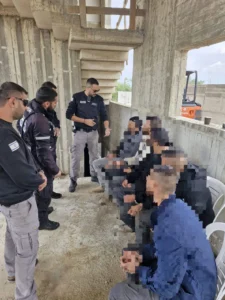
Five Palestinians without residence permits were detained at a construction site in central Israel in December 2025
Josh Breiner reports in Haaretz on 14 January 2026:
A shortage of space in Israeli prisons is causing police to detain suspects in unfit holding cells, rather than transferring them to Israel Prison Service detention facilities, according to several cases that have reached the courts.
Dozens of detainees have been crowded into small cells intended for only a few individuals, and others have been held in a police station for the entire night without a place to sleep. Some slept on the floor or on metal chairs.
In one case this week, a Palestinian arrested on suspicion of entering Israel without a proper permit was held overnight in an open-air cell in the Jerusalem Hills, with his ankles shackled and without shoes.
The detainee described the conditions as sitting “in a cage with damp blankets.”
“The ankle cuffs were tight, and I was shackled the whole time. I didn’t go to the bathroom for four days,” he said. His attorney, Fares Mustafa Ali, told the Jerusalem Magistrates Court that his client was held without walls, in the cold, without basic amenities.
The judge ruled that the detainee was being held in conditions “that are likely to harm his health and dignity.” “The respondent is being held in a cell without walls, with all that this implies, given the cold Jerusalem winter,” Judge Ofir Tishler said. “And according to his claim, which was not refuted, he was shackled by the ankles and wrists for the entire duration of his stay.”
In two separate cases in southern Israel, large numbers of detainees were crowded into cells designated for far fewer people. During a hearing last week concerning five individuals suspected of being in Israel illegally, it emerged that 34 detainees were being held in a single cell at the Arad police station.
“I arrived to provide legal counsel and approached the detention cell,” Defense Attorney Ayelet Cohen told the Be’er Sheva District Court. “I approached the large cage where the detainees were held – they were all standing,” she said, comparing the situation to “sardines.” “I don’t understand how 34 people can sleep in a cell under degrading conditions,” she said. “How can human beings be housed in such conditions?” She said that when the detainees asked to go to the bathroom, “They were told to defecate on each other.”
Judge Daniel Ben-Tolila rejected the release appeal and left the five in detention. “I will not deny that these are far from optimal conditions, to say the least,” he wrote. “However, this is a preliminary period of detention. An ad hoc solution for one day.”
In another case, police held 21 suspects of unlawfully entering Israel without a permit in two jail cells designated for at most six people. “The cop told me, ‘Who do you think you are?’ and said that I’m a Shabakh,” the name for undocumented West Bank Palestinians who crossed into Israeli territory, “and I have no rights in this country,” one of the detainees told the court. “We all shared a single day-old sandwich and slept all night in a waiting room. We are sitting on metal chairs.” According to the defense attorney, five of the detainees were held in these conditions for five days.
Asked about the difficult conditions, a police official told the court, “I have no answer to give.” He said arrests have increased “to an abnormal extent. We’re talking about 80 illegal border crossers.”
Judge Ben-Tolila told the police, “However important it is to secure the country’s borders, it is not enough to detain unlawful residents without sufficient accommodations in place to hold them,” he wrote, adding that “the number of detainees at police stations far exceeds the stations’ capacity.” As a result, the judge ordered the release of four of the five detainees.
“The unlawful detention of detainees in police station holding cells has become a worrying phenomenon, which is a direct outcome of a deepening incarceration crisis,” said Netanel Lagami, deputy national public defender. He emphasized, “Suspects, some of whom are innocent, are being held without a bed or medical attention – conditions that raise serious concerns about coerced or false confessions.” When asked for a comment, police said, “Unfortunately, in the cases raised in your inquiry, there is a shortage of detention spaces, and the police are forced, against their will, to hold and guard detainees in holding cells.”
The police maintain that the responsibility for holding detainees “lies with the Israel Prison Service,” noting that “a shortage of detention cells in the IPS must not come at the expense of policing or the arrest of suspects, nor lead to the release of suspects who pose a danger to the public or a risk evading justice.”
This article is reproduced in its entirety