

Slow genocide: Death and displacement continue in Gaza months into ceasefire
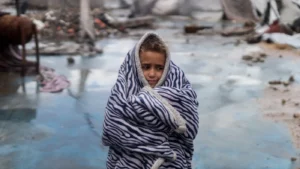
A displaced Palestinian girl shields herself from the cold as she stands in front of her family’s tent after it is damaged by a storm at a displacement camp in Gaza City on 13 January 2026
Maha Hussaini reports in Middle East Eye on 15 January 2026:
The ceasefire has stopped most of the bombs, but not the cancer eating away at Najat Sayed al-Hessi’s body. The 61-year-old Palestinian from Gaza has been waiting for her monthly cancer medications for 27 months, without receiving a single dose.
“Nothing has changed for cancer patients in Gaza since the ceasefire,” she told Middle East Eye, as the disease continues to progress unchecked. “I had an appointment to travel to Ramallah for my medication and injection on 7 October 2023, the day the war began,” she added from her makeshift tent in Deir al-Balah. “I couldn’t go that day, and I have been waiting ever since.”
Since the war started, medical referrals outside Gaza have stopped, and hospitals in the war-battered enclave are unable to provide even minimal treatment for cancer patients. “I fear the disease is advancing in my body with each passing day,” al-Hessi said.
Her plight reflects the wider crisis in Gaza, where nearly two million people continue to live under dire conditions three months after the ceasefire. After two years of Israeli bombardment, much of Gaza’s civilian infrastructure and public health system has been destroyed.
People had hoped the October ceasefire would bring some respite and a gradual path to recovery. But with continued Israeli restrictions on border crossings, aid, and goods, residents feel the situation has merely shifted from an intense genocide to a slower-paced one.
For those like Al-Hessi, the pause in fighting has brought no pause in suffering.
Banned medications
Al-Hessi is one of 11,000 cancer patients in the Gaza Strip. Around 3,500 hold medical referrals for treatment outside the territory, but Israeli authorities have not allowed them to travel. She received a referral six months ago, but it has been ineffective due to closed borders. On a recent visit to her local clinic for back pain, she found no medications available, leaving her without relief for a slipped disc and osteoporosis.
“I asked them to give me anything, at least some vitamins, but they said they had nothing for my case,” she recalled.