

Gaza’s digital economy in collapse amid blockade and telecom destruction
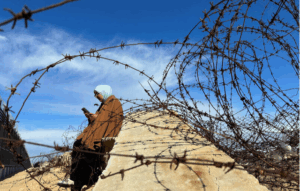
A displaced Palestinian woman tries to get internet service on her phone through the Egyptian networks to communicate with her relatives, near the border with Egypt, in Rafah, southern Gaza, 1 February 2024
7amleh – The Arab Center for the Advancement of Social Media releases a new report titled “The Impact of the Gaza Blockade and the Destruction of Telecommunications Infrastructure on the Digital Economy Amidst Genocide” by Dr. Mohammed Alshurafa on 29 December 2025
The report documents how Israel’s long-standing blockade—combined with the systematic destruction of telecommunications and power infrastructure since October 2023—has pushed Gaza’s digital economy into collapse. What was once a fragile but vital lifeline for young freelancers, remote workers, and digital entrepreneurs has been shattered, cutting thousands off from income, education, information, and the ability to reach the outside world.
Drawing on a post-October 2023 survey of 183 participants and 30 in-depth interviews, the findings show a predominantly young digital workforce (81% aged 18-34, with 72% displaced) struggling to survive amid recurring blackouts, disrupted payments, contract cancellations, and the breakdown of professional networks.
The report finds a daily collapse in connectivity and severe internet disruptions that undermine work and communication, an income freefall as most respondents lost over half their earnings, and widespread contract cancellations with reputational harm (86%) linked to electricity and connectivity failures that trigger penalties on freelance platforms. It also documents payment discrimination that forces risky, costly workarounds, and warns of major humanitarian impacts from destroyed telecom infrastructure and repeated blackouts—echoed by external monitoring showing Gaza’s internet traffic fell by over 80% in October 2023.
“The collapse of Gaza’s digital economy shows how the blockade and the systematic destruction of telecommunications infrastructure operate as structural violence, cutting people off from work, education, income, and global connection, and eroding their ability to build sustainable livelihoods. This reality leaves the population increasingly vulnerable and dependent on humanitarian aid,” said Dr Mohammed Alshurafa, author of the report.
“Gaza’s internet is a lifeline. When power and connectivity are destroyed, Palestinians in Gaza lost livelihoods, safety, and the right to communicate,” said Nadim Nashif, Director of 7amleh. “Reconnecting Gaza is a humanitarian necessity, and accountability is a matter of justice.”