

How the US-Israeli ‘peace plan’ will partition Gaza
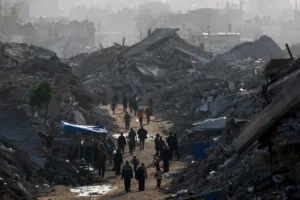
Palestinians walk among piles of rubble in northern Gaza on 19 November 2025
Jonathan Whittall writes in Al Jazeera on 22 November 2025:
Since the ceasefire was announced on October 10, the division of Gaza into a so-called “green zone” under Israeli army control and a so-called “red zone”, where Palestinians have been displaced and contained, has solidified. Separating the two is the invisible “yellow line”.
The administration of United States President Donald Trump has signalled that reconstruction will be limited to the “green zone” where Israel and its allies have been working on plans for so-called “alternative safe communities”.
Although there are reports last week that these plans were dropped, colleagues in the humanitarian field have informed me that the first such community is still slated to be built in Rafah, southern Gaza and a further 10 are planned along the yellow line and into the north.
If plans for these “safe communities” proceed, they would cement a deadly fragmentation of Gaza. The purpose of creating these camps is not to provide humanitarian relief but to create zones of managed dispossession where Palestinians would be screened and vetted to enter in order to receive basic services, but would be explicitly barred from returning to the off-limits and blockaded “red zone”.
These plans represent a recycled version of what Israel has long wanted to do in Gaza. The creation of “bubbles” – an initial, telling euphemism that I first heard proposed by the Israeli authorities when I was part of coordinating humanitarian operations in Palestine as a United Nations official – was the first iteration of areas where Palestinians would be screened and would be conditioned to receive controlled assistance.
This is the grim reality of the so-called ceasefire deal in Gaza. It will not deliver peace; it will further shatter Gaza and the prospect for Palestinian sovereignty into pieces. If anything, it is a Gaza piece plan.
On Monday this week, the United Nations Security Council voted to legitimise the plan by endorsing a board of peace to manage Gaza and an international stabilisation force (ISF) to provide security. But what areas will these forces secure? There is no agreed-upon peace for these forces to keep. According to maps I have seen of the “alternative safe communities”, the ISF would be positioned along the yellow line and would secure these newly established camps.
Hamas has unsurprisingly rejected the UNSC resolution. It was obvious that its provisions were not the outcome of a negotiated agreement. In the 20-point Trump plan, which was attached as an annex to the resolution, point 17 may now be invoked: “in the event Hamas delays or rejects this proposal, the above, including the scaled-up aid operations, will proceed in the terror-free areas handed over from the IDF [Israeli army] to the ISF”. In this way, the “alternative safe communities” may become the only enabled aid delivery centres, thereby prolonging the total blockade on Palestinians in Gaza.