

Bad faith, duplicity and cynicism: Britain’s Palestine Mandate, 100 years ago
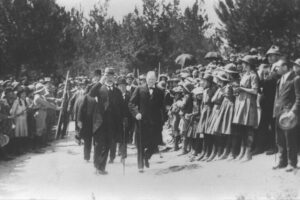
British Home Secretary Winston Churchill (R) escorted by High Commissioner Herbert Samuel, in Jerusalem during the British mandate period
David Kattenburg writes in Mondoweiss:
Another speech fest at the UN General Assembly has come to a close. “Debates,” the week-long session is called. One by one, leaders of the UN’s 193 member states deliver high-minded declarations about what the world’s supreme governing body should or shouldn’t do.
As it happens, this year’s round of jaw-wagging coincides with the hundredth anniversary of the birth of an unfortunate situation the UN continues to bear responsibility for and has the ability to resolve — a situation one of its founding members created; arguably the oldest unresolved item on the UN’s 78-year-old decolonization agenda: the Palestinian people’s thwarted right to self-determination, as provided for by the UN’s predecessor, the League of Nations.
A hundred years ago today, on September 29, 1923, the League of Nations formally assigned Britain the role of Mandatory Power in Palestine. Its mission: to guide Palestine’s people out of colonialism, into independence. Instead, in one of modern history’s most egregious acts of bad faith, duplicity, and cynicism, the world’s preeminent colonial power handed Palestine over to European colonists, dispossessing Palestine’s native people and sowing the seeds for a hundred years of bloody conflict and grief.
Britain’s fiduciary duty had been set forth in the 1919 Covenant of the League of the Nations. Article 22 of the Covenant stated:
“Certain communities formerly belonging to the Turkish Empire have reached a stage of development where their existence as independent nations can be provisionally recognized subject to the rendering of administrative advice and assistance by a Mandatory until such time as they are able to stand alone. The wishes of these communities must be a principal consideration in the selection of the Mandatory.” [emphasis added]
And:
“To those colonies and territories which as a consequence of the late war have ceased to be under the sovereignty of the States which formerly governed them and which are inhabited by peoples not yet able to stand by themselves under the strenuous conditions of the modern world, there should be applied the principle that the well-being and development of such peoples form a sacred trust of civilisation.” [emphasis added]