

Israel: a war among brothers
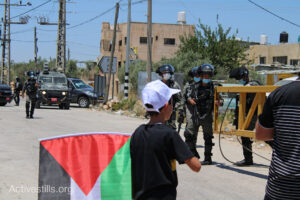
The occupation barely figures in the concerns of the Israeli protest movement. Credit: Oren Ziv / Activestills
The attempt by Israeli Prime Minister Benjamin Netanyahu’s far-right government to consolidate power by overhauling the country’s judicial system has been described as many things over the past eight months: a coup, regime change, a constitutional crisis. From the beginning, Israel’s president, former prime ministers, members of parliament, analysts and others have also been warning that the radical scheme to neuter the judiciary—and the massive backlash it unleashed with over 30 weeks of mass protests—could lead to civil war. In recent weeks, more and more Israelis have been asking a once-unthinkable question: whether the country is already in the midst of a civil war.
But civil war refers to war among citizens. Momentarily overlooking that Israel rules undemocratically over millions of Palestinian non-citizens, the social ruptures playing out in the streets of Tel Aviv and Jerusalem entirely exclude non-Jews, even those with Israeli citizenship. The Hebrew term “war among brothers” is much more appropriate, says Orly Noy, a veteran Israeli activist and journalist. That war is between secular Jewish Israelis and a cacophony of more religious Jews, including the settler movement.
“When I speak about civil war, it’s not about people taking up guns against each other in the streets,” Noy says in an extensive interview with Democracy in Exile. “It’s about determining the nature of the state and the understanding that we cannot be a Jewish state but also a secular state and a democratic state, but also an occupying state and an apartheid regime, all while being a liberal state.” One side wants a complete separation of church and state, the other side wants something more akin to a theocracy dominated by ultra-Orthodox rabbis and the most violent and messianic settlers.
“With regards to the ultra-Orthodox, I have a lot of sympathy for them, especially as a Jerusalemite,” Noy explains. She emigrated from Tehran to Jerusalem at the age of nine, two weeks after Ayatollah Khomeini seized power in Iran. “They are part of the city, and that’s one of the reasons I love the city,” she says of the ultra-Orthodox. “But I can no longer ignore their vision for Israel and for Jerusalem. That’s a nightmare for me. It’s the nightmare we escaped when we left Iran.”
Noy is a journalist and editor at the Hebrew-language news magazine Local Call who also translates Farsi literature and poetry into Hebrew. She is a veteran activist in the Mizrahi justice movement, one of the only Jewish Israelis to ever run for the Knesset on behalf of the liberal Palestinian party Balad, and the chair of the board of Israeli human rights organization B’Tselem. In addition to all that, she is one of the few analysts I know who manages to be uncompromising in her values while managing to maintain actual empathy for her political opponents.