

Support Israeli NGOs’ campaign for Palestinian water rights
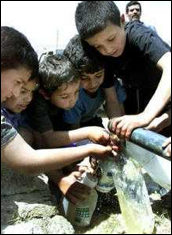
photo: if americans knew
First posted 21 July 2009, updated 9 August
See also the article on the water convoy on this website as well as the background information below.
Donate:
Cheques can be made to Rabbis For Human Rights, 9 Harechavim St. Jerusalem, 93462, Israel or to account No.153380 in Bank Hapoalim branch 782, Aza, Jerusalem.
In Britain donations may be sent via the British Shalom-Salaam Trust:
By cheque payable to BSST and sent to: BSST, PO Box 39378, London SE13 5WH – quoting ‘water campaign’
By bank transfer to HSBC sortcode 40-04-15 – account no 11576585 – international bank account number GB22MIDL40041511576585. Please quote your surname and initial
By credit card via CAF (they claim Gift Aid and deduct 5% of the total) quoting (name of campaign/organisation) in their instruction box
Please email bsst@bsst.org.uk if you’re paying by credit card or bank transfer so we can ensure the transaction is processed correctly and quote “Water campaign” so we can allocate the funds speedily.
You can increase your donation by 28% by sending BSST a Gift Aid declaration.
If you haven’t already completed one, please include this with your cheque, or by email to bsst@bsst.org.uk: “I wish that this and any future donations to the British Shalom-Salaam Trust (charity no 1103211) be treated as Gift Aid donations until further notice.” (Donors should make this declaration only if they pay UK income tax or capital gains tax at least equal to the amount of tax recoverable by the British Shalom-Salaam Trust.) NB your postal address must be included.
Organisations participating:
Humans Without Borders, Anarchists Against Walls, Young Communist League of Israel, Bat Shalom, Gush Shalom, ICAHD, the Public Committee Against Torture in Israel, Alternative Information Center, Hadash Party, Yesh Gvul, Combatants for Peace, Communist Party of Israel, Meretz Party, Sadaqa-Reut, Coalition of Women for Peace, Physicians for Human Rights-Israel, New Profile, Machsom Watch, Rabbis for Human Rights. Taayush-Arab-Jewish Partnership, Tarabut-Hithabrut.
Details and comments: Yuval 050-7336117, Yakov 050-5733276, 09-7670801 email manor12@zahav.net.il
Background
Dry water taps – no water for drinking or bathing, many months during the summer heat. Since March this is the situation of many families in the villages Qarawat Bani Zayed, Kufr ‘Ein, Ramani & Nabi Salah, 15,000 people. In the same time, these Palestinian villagers can see beyond the settlements’ fences a different situation. They see green lawns and sprinklers irrigating the whole day. A similar situation exsists in many other parts of the West Bank.
Since the occupation in 1967, Israel took control over most of the water sources in the West Bank, and uses them for Israeli clients and especially for settlers. The mountain aquifer is considered a joint (Palestinian-Israeli) water reservoir that Israel is permitted to use – but not in the current way when 80% of the water is taken by Israel and the remaining 20% are allocated to the millions of Palestinian inhabitants. Other water sources, as in the Jordan valley, are used almost exclusively by Israelis and only meagre quantities are left for the usage of Palestinians. The Palestinian inhabitants of the south Hebron area having a serious problem of water shortage as well. In Israel and the settlements, the mean per capita water consumption for domestic and municipal usage is 235 litres per day, and in the occupied territories it is 66 litres per day only. 227,500 people in 220 villages are not connected to the water system. An additional 190,000 people have only partial water supply.
The Oslo accords reaffirmed the Israeli control over the water supply and pumping. The Palestinians assumed that it was a temporary agreement, and according to the time table that was established then, by May 1999 an independent Palestinian state would be established with control over its natural resources. The continuing water shortage increases the anger and frustration the Palestinians feel.
The small quantity of water supplied to the Palestinians is not distributed equally. As the water runs through the pipes the quantity reduces and as a home is situated higher up the pressure diminishes, and as a result the highest situated homes do not receive supply at all.
The village Qarawat Bani Zayed, situated on a mountain slope, is an example to this difficult situation. Lately Israeli peace activists visited this village and heard of this difficult situation. Many inhabitants of this village have to purchase water from water tanks at high prices – up to NIS 40 to 1 cubic metre of water, ten times its price in Israel or the settlements. Abud spring that gave them water before the occupation was caught by Mekorot, the Israeli water supply company, and only a small portion of its water currently arrives at the village.
Supplying enough water to the Palestinian civilians – for their homes, public and agricultural needs is not a favour or act of compassion. This is a legal and moral obligation whose violation is a serious crime against international law.
keyword: watercampaign