

Angry man evokes the rage and beauty of life in occupied Palestine
The righteous chronicler of life in Ramallah
Anger co-exists with a sense of beauty in a valuable journal of West Bank life
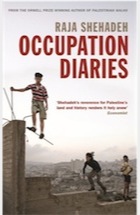
Review of Occupation Diaries by Raja Shehadeh
Jonathan Heawood, The Observer,
August 05, 2012
Raja Shehadeh is an angry man. He is angry about the Israeli occupation of the West Bank, the illegal settlements that dot his beloved Palestinian landscape and the roads that divide the people of this territory. And he is angry about the failure of Israel’s allies and donors to prevent the discrimination against Palestinians and Israeli Arabs that he encounters in his life as an activist and a lawyer.
Shehadeh is also a contemplative man, a walker who meditates, tends his garden and writes about his daily life in Ramallah with great simplicity and beauty. His first memoir, Strangers in the House, was published 10 years ago to warm reviews, but it was Palestinian Walks that drew a wider audience to his work and won the Orwell prize for political writing in 2008. It combined an intimate account of six walks through the Palestinian landscape with a devastating analysis of the politics of land ownership.
Shehadeh’s anger in that book was modulated through his observations of the natural world. In these diaries, which cover the period 2009-11, the emotions are more immediate and rawer. Shehadeh’s anger extends beyond the political domain and into his personal life: he is even angry with the dental assistant who addresses him in Hebrew. “Hearing Hebrew over the telephone aroused insecurity and fear, recalling earlier times when I received calls summoning me for interrogation by the military.” Truly, in Ramallah, the personal is political.
Shehadeh notes the destructive potential of his anger, knowing that it is easy to dismiss an angry spokesman. At times, though, it seems that he uses it to sustain himself when beauty is not enough: “I want to continue to feel the anger and to rage, rage against the dying of the light.” These raw emotions are also linked to the death of his mother, just before these diaries open. She was exiled from her home city of Jaffa in 1948, and watched her family’s wealth disintegrate. In remembering the turbulent 60 years that followed, in which she lost her family, friends and property, he finds himself “still angry at what she had to suffer”.
This heartfelt rage and frustration oscillates with Shehadeh’s continuing sense of beauty, his enjoyment of his garden and his appreciation of “how lovely life is, how dearly we should cherish and cling to it”.
He watches the Palestinian Authority pursuing a vigorous campaign for full membership of the United Nations. The emblem for this campaign – a gigantic replica of a UN chair – is installed at the centre of Ramallah as a symbol of Palestine’s desire for a seat at the table. Shehadeh drives past this with somewhat raised eyebrows. He is almost as sceptical about the Palestinian leaders as he is about their Israeli counterparts.
But his spirits are lifted by the Arab Spring and its implications for Israel and Palestine. His diary entries in early 2011 are filled with a sudden rush of exhilaration as the possibility of profound and peaceful change flashes before him. Now the anger is pulled away, like a curtain, to reveal the desperately thwarted hope that lies behind it. Shehadeh dares to imagine a future in which Israel, Palestine and the other eastern Mediterranean states co-exist within a federal structure akin to the European Union. He traces this dream through the shared history of the region, in particular the Ottoman era, during which grand engineering projects linked these territories together by rail. “Not that we should call for a return of anything resembling Ottoman rule – the Ottomans were brutal and inefficient – but, rather, a return to the way things were organised then, with communities and cultures united.”
This ambitious vision seems increasingly remote as Syria descends into civil war and the deadlock between Israel and the Palestinian Authority shows no sign of relaxing. Yet Shehadeh’s rare blend of rage and contemplation gives him the resilience to keep working towards this seemingly impossible dream. He reminds us that France and Germany, mutual enemies for a thousand years, now share a cultural institute in the West Bank.
Shehadeh is a committed diarist who has been keeping a journal most of his life and surely his eyes and ears will remain open to these continuing upheavals, just as he continues to watch the dappled light coming through the gazebo covered with vines in his garden. We can only hope that he and his publishers continue to bring us his precious commentary on life inside one of the world’s greatest political fault lines.
Jonathan Heawood is director of programmes at the Sigrid Rausing Trust.
Occupation Diaries
Raja Shehadeh
Profile £12.99, pp208